
Techniques – raku
Raku ceramics
Raku, a ceramic enameling technique, originally from Korea, was developed and institutionalized in Japan in the 16th century. Earth, air, fire and water express their natures simultaneously under the fundamental constraints of the firing process, conferring infinite variation, and making each piece unique.
This rapid firing technique subjects the clay to temperature extremes, due to extracting an incandescent piece from the kiln, to undergo immediate cooling in the open air. A piece may be smoked, soaked in water, burned or left in the open. The pieces are hardened at 800°to 850° Celsius. The enamel (watertight colored varnish)is fired between 820° and 980° C for one to two hours. Weather conditions may provoke thermal shock due to unforeseen temperature variations: suddenly dropping from 900° to 20° C or less. Then the piece is immediately covered with flammable material, such as sawdust, and enclosed in an airtight container. During this smoking stage the characteristic cracks and carbon blackening occur.

This art form flourished in 16th-century Japan during the Sengoku period. The meeting between Chōjirō, a Japanese potter, and Sen no Rikyū, master of the tea ceremony, led to innovations inspired by an original Korean craft, particularly dedicated to tea bowls. For nearly 450 years, the Raku family preserved and refined this tradition.
The tea ceremony (chanoyu) shares similarities with Zen Buddhist rituals, embracing the aesthetic principles of kanso (simplicity), funkinsei (irregularity), and shizen (naturalness)—concepts echoed in the wabi-sabi philosophy, which values imperfection and a return to natural origins.
Today, Raku has evolved, merging traditional Asian influences with contemporary artistic expressions. Unlike in Japan, Western adaptations embrace the unpredictable effects of smoke, adding a unique dimension to the process.
Kintsugi
Kintsugi, a Celebration of Imperfection
Kintsugi, or “golden joinery,” is an ancient Japanese art dating back to the late 15th century. Originally developed to repair broken porcelain, it involves mending fractures with lacquer and powdered gold, creating a striking contrast that enhances rather than conceals imperfections. Deeply connected to the Japanese tea ceremony, Kintsugi embodies a philosophy that honors an object’s history and the passage of time.
Rather than marking the end of an object’s life, breakage becomes the start of a new chapter. Instead of hiding repairs, they are accentuated, symbolizing resilience and transformation. The fragments of a shattered piece are carefully gathered, cleaned, and reassembled with natural lacquer before their “scars” are delicately dusted with gold.
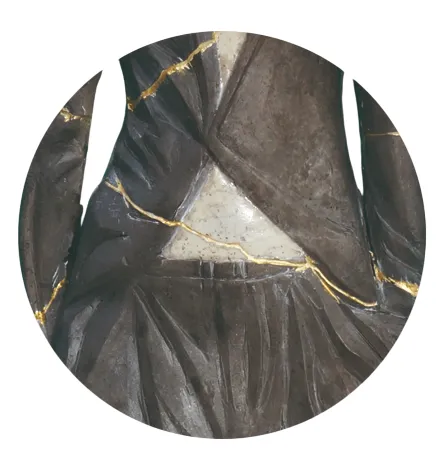
In this sense, kintsugi belongs to the Japanese philosophy of wabi sabi, a celebration of imperfection. This Asian philosophy, combined with Zen concepts, elevates acceptance and contemplation of imperfection and change. These values, resonating in a contemporary context, incorporate two fundamentals: wabi, referring to the fullness and modesty inspired by nature and sabi, respect for the work of humanity and its history.
An artful repair transforms the piece into an expression of transcendence.
By applying this philosophy to one self, kintsugi acts as a form of “arttherapy” divulging injuries as milestones, encouraging their acceptance and eventually liberating them.
” The once-broken object, mended with care and then honored, assumes its past and paradoxically becomes more resistant, more beautiful and more precious than before the trauma. “
Céline Santini ; Kintsugi, l’art de la résilience
Ceramic baking process


